I Hide My Chocolate

Midlife observations

My name is Sally and I weigh 123.4 pounds.

IMG_0073

Addicted to the Scale?

I weigh myself on Monday mornings.  I am the first person up.  I tip-toe into the bathroom.  (I still move like a dancer.)  I turn on the shower so that the water gets really hot.  (I love getting lost in the shower with hot water surrounding me.)  I pee. (It’s important that all possible fluids be eliminated.)  I strip naked.  (It’s important to not be weighed down by any clothing…my threadbare pajamas must weigh at least a pound!)  I pull out the scale from its somewhat unobtrusive and hidden location.  (I don’t want my daughter to get the scale addiction.)  I step on it.  I hold my breath.  The digital numbers flicker back and forth before settling into this week’s verdict.  Aha!  Under 125 pounds.  My current magic boundary.  I weigh as little as I’ve weighed since I was married 19 years ago.  I feel ridiculously proud and virtuous about this dubious achievement.  What a way to kick off the week.

My mother’s scale was in their walk-in closet – a small, dark, private room that always fascinated me.  My mother’s clothes on one side and my father’s clothes on the other side.  Hidden treasure boxes of old jewelry, old photos and other mementos on the shelving high up.  This was where the Christmas presents were stashed away.  She was not particularly modest.  Dressing, undressing, bathing with doors open.  I liked to sneak in when no one was there.  Trying on her clothes.  Trying on her shoes.  Curious about her bras and under-garments.  Examining the old jewelry, wondering if any of it fit me.  Wondering about what I would be like when these grown up womanly items did fit me.  She weighed herself every morning, naked.  I did too.

At 10, I already weighed over 100 pounds and was “pleasantly plump.”  (My father’s words.  He used the same phrase for the Rubenesque nudes in the art he loved so much.)  He loved ice cream and we had it every night.  Usually Baskin & Robbins French Vanilla.  Or Peppermint – my favorite flavor.  He carefully measured out a precise serving.  No over indulgence allowed.  Or we had 2 cookies, usually Oreos or Fig Newtons.  My mother had none.

In Paris, during our one truly extravagant family vacation before high school, my father and I sampled chocolate mousse at every restaurant.  That trip was where I developed my taste for intensely dark chocolate and strong coffee.  In Florence, the men wouldn’t stop touching me.  It was an early taste, at 13, of sexually aggressive unwanted male attention to my “pleasantly plump” curves.

Entering high school where boys and girls began to do more than eye each other with curiosity from afar, I became sure that “pleasantly plump” was not what I wanted to be.  Ambivalent about my curves and their impact on men and confused that “Pleasantly plump” became “Better not eat that, you’ll get fat,” I found myself in the mirror-lined ballet studio.  In a leotard.   About 15 pounds heavier than the ethereal tall, thin, breastless ballerinas I began to admire.  Having reached puberty at 11 with a mesomorph’s solid and strong body, there was no way I was going to transform into an ectomorph.  But I could try.  And so I did.  I upped my weekly dance class to twice, 3x, 4x, every day except Sunday.  When that wasn’t enough, I started taking two classes daily.  I learned the calorie counts of every food item and began to mete out allowable calories obsessively.  About 1,500 calories.  (For someone dancing 4 hours a day, 1,500 calories was starvation.)  Starving yourself is impossible to sustain.  So I would swing in the other direction and binge on large quantities of food.  Alone.  In secret.  I couldn’t eat normally in public.  Terrified of getting fat.  Terrified to be thought of as beautiful and desirable.  When I binged, I felt bad.  Guilty.  Ashamed.  Embarrassed.  Fat.  I had to punish myself.  So I would run.  Take another dance class.  Eat even less the next day.  I tried the-vomiting-thing a few times.  It really disturbed me on so many levels.  It was gross.  And I didn’t want to admit I had a problem.  Avoiding vomiting helped me remain in denial that I had an eating disorder.  Maybe other ballerinas did it, but not me.  Instead I figured out how to keep my eating swings tightly controlled in my disciplined way.

Over the course of that year, I became incredibly strong and incredibly thin.  I liked being thin.  I liked hitting weight-loss goal after goal.  Clothes looked good on me.  I liked the breastless version of myself that I saw in the ballet studio mirrors.  I liked being hungry.  It made me feel alert and better than the other girls.  I could resist food.  (Except when I couldn’t.  But I kept that to myself, hidden.)  My weight got down to about 100 pounds.  My parents never said anything.  Did they not notice that their pleasantly plump daughter was now breastless and bony?  It was dear, honest Emily, with the scale dipping to 98 pounds, who exclaimed, with true alarm, that she could see my ribs!  I liked that my ribs were showing, but it jarred me enough to reconsider this aesthetic when she expressed such alarm.  100 pounds became my magic boundary.  The low boundary.  If I didn’t drop below 100 pounds and I didn’t make myself throw up, then I didn’t have an eating disorder.  I carefully put on a few pounds.

By the end of high school I was a healthier weight and had given up ballet.  Off I went to college where I easily gained the Freshman 15.  And hated myself for it.  To punish myself, I returned to ballet and 100 pounds.  It felt good to be in control and thin again!  But I was so unhappy.  Through therapy and time, I learned how much food I could eat and how much exercise I needed to maintain a more normal weight.  Love and my marriage helped.  I was busy and happy.  I was so busy and so happy that I threw away my scale.  Hooray!  I was done with eating issues.  Besides, I wanted to set a good example for my daughter.  I so wanted to have a healthy relationship with food and to model normal eating behavior for her.  But she knows me.  I measure everything.  I don’t allow myself dessert except for maybe a yogurt or some very dark chocolate.  I control my portions so carefully that I can neither tolerate sharing my food (it’s my allowance of food not yours) nor do I have room for any serendipitous treat offered to me (I ate my allowance already).  I can’t just stop when I’m full.  Because I don’t know when I’m full.  I’m too obsessed with weighing what is the right thing to eat; what is the right amount to eat.  I am too busy thinking to feel.

There was an easier time with my eating during courtship and early marriage where we ate out, we cooked in, we enjoyed food together.   And then my 40’s happened.  What isn’t discussed about disordered eating (to my knowledge) is that it COMES BACK!  Just when you think you’ve got the eating thing figured out, its ugliness reemerges when you’re looking at middle age staring back at you in the mirror.   If I could just lose 5 pounds, 10 pounds, 15 pounds, I will look younger, feel better, sleep more soundly, defy death.  When my age creeped over 40 and my weight creeped over 140, I went into action.  Back to the ballet studio, I bought a scale.  I got thin and strong again.

Of course it is different as a more experienced adult.  I don’t swing between extremes the way I used to.  A calmer yoga practice has replaced an obsessive pursuit of ballet.  I don’t punish myself.  I do enjoy food.  But my enjoyment of food remains controlled.  The anxiety hovers under the surface.  Intellectually, I know five pounds doesn’t make a difference in who I am.  Intellectually, I know maintaining that magic boundary on the scales is not what makes me happy.  Now I can laugh at how ridiculous it all is, while acknowledging its presence.  It’s part of who I am.  Stepping naked onto the scale every Monday morning, I am aware that I let the scale’s verdict influence my self-esteem.  Stepping naked onto the scale every Monday morning, I remind myself to breathe, to be grateful for my strong body, to enjoy my chocolate, and to not let the scale’s verdict influence my self-esteem.


Before You Die

IMG_0070

Dear Mom,

How well do we know our mothers?  As children, we focus on our own survival and development.  Our mothers support this behavior, desiring us to be happy, safe, and loved.  Our mother’s life before us is mysterious except as it pertains to our own personal development.  Our mother’s life after we grow up and leave home is a sidebar to our more interesting-to-us life, at least until her life makes the shift to requiring us to take care of her, to take notice of her.  Or until we realize that every essence of our being is infused with every essence of her being.  Learning about her, we learn about us.

When I was told that my mother had been brutally stabbed by her second husband before he killed himself, I was a young girl.  Too young to fathom this fact.  And so I did not.  Occasionally I would tell the sensational story to garner a reaction from a new friend.  It was a scintillating factoid that I thought made me interesting.  For the most part, I did not think my family was very interesting.  We did not fight.  There were only three of us.  We diligently pursued our activities and goals, with little demonstrative emotion.  This isolated nugget of sensation – that we never talked about – seemed so unbelievable and out of character that eventually I questioned its truth.  Did this really happen to my mother or am I making it up?  What did she do with the fear and emotion?  How has this event shaped her life, my life?

As my mother turns 91 this year, living…surviving another year, I am reflecting on her life and the end of her life.  I feel urgency to know what I can of her before her mind fades, before she dies.  How much more time do I have with her?  For her 90th birthday a year ago, I made the pilgrimage home to visit with her.  I set up the visit to have time with her, to ask her the questions I have never asked.  So much is unspoken.

  • Are you happy?
  • You are so successful, why did you end up with men who were self-centered and abusive?
  • How did you fall in love with Dad?
  • Is there anything you want to say to me?
  • What do you hope to be remembered for?
  • Would you do anything differently?
  • What advice to you have for your granddaughter?
  • What does it feel like to be at the end of your life?
  • Are you ready to die, afraid to die?
  • Do you believe in God?

I mustered up my courage to ask the questions and vowed to keep probing instead of sinking into docile silence with the first answer I got.

My mother was born in 1922.  Her father, a physicist, dropped dead suddenly of an aneurism when she was just 7.  She told me how every morning she went to her father’s room to say good-morning.  Clearly there was a special bond between him and her.  On the morning after he died, she was not allowed into his room.  She never saw him again and grieving was not tolerated.  What a devastating loss for her!  Her mother was a no-nonsense, undemonstrative woman who then had to hold the family together in the Depression.  She took on boarders, taught school, and did not have a lot of time for my mom.  My mother was painfully shy, sad and lonely, and was homeschooled because school was socially challenging.  Although she was drawn to art and more introspective and creative activities, she was encouraged to pursue science and academia.  She was good at school so she just kept going to school.  Kept going until she received her Ph.D. in 1950 – an unusual accomplishment for a woman in 1950.  But it was a more passive accomplishment than I realized.  She didn’t know what else to do with herself, so she kept going to school.  Her first husband was a fellow graduate student.  I am not sure what broke apart that marriage other than youth.  Her second husband had a history of drug addiction and mental illness.  My mother was discouraged from marrying him, but she went forward with it anyway.  My father once said to me, as I was embarking on my own marriage, as if to explain the mystery of attraction to himself, “You can’t help who you fall in love with.”  What a destructive act of self-sabotage on her part.  It did not end well.  I don’t know much more than that.  There is still a shroud of “don’t talk about that” in our house.  It took several years of therapy for her to recover from the violent attack, from the violent betrayal.  She moved to Washington and met my father.  He thought she was beautiful.  She loved being loved.  They married in 1961 and I was born in 1962.  She was desperate for a baby, for the family she did not have.  The story of my birth is told by my parents as if it was a miracle.  I was delivered by emergency C-section (her life-giving scar always fascinated me).  We both almost died.  Post miracle, she was felled by post-partum depression, rejecting the baby she so desperately wanted.

How did she recover from this post-partum depression?  What impact did her rejection of me have on me?  How did her trauma carry over to me?  My main sense of her as a mother is that she was very devoted to me.  She adjusted her work schedule to be home for me.  She spent a lot of time with me: reading together; teaching me how to cook, sew, do algebra; going to the ballet together.  She thought I was wonderful and gave me a lot of freedom to explore my interests.  Indeed, I could do no wrong.  I remember very few instances when she got angry with me or set limits for me.  But there were significant ways in which she was absent.  She was not physically demonstrative.  Very little hugging happened in my childhood.  The only times I remember my mother touching me were when I was ill.  I managed to be ill a lot.  All sorts of maladies kept my mother hovering over me, from hypoglycemia to migraines.  These illnesses kept me home, were an excuse for me to avoid.  Avoid parties that made me shy, avoid deadlines that seemed insurmountable to my perfectionism, avoid living in all its messy imperfection.  When I was sick, I was allowed to move into her bed where she would lie next to me, reading out loud or watching bad tv sitcoms and game shows endlessly.  In her desire to love and nurture, she neglected (or was unable) to model what a powerful and effective woman was.  Bereft of her father, abused and abandoned by her second husband, she did not know how to stand up to my father when he was boring, compulsive, remote, abusively inflexible and insistent to her, to me.  She and I stuck together, forming a strong mother-daughter bond built on a love of all things female (Jane Austen, Mary Tyler Moore, tea sandwiches at The Birdcage) and a suspicion of all things male (money, sports, confrontation).  But her desire to give me freedom meant that she was absent as a parent in many key ways.  She was unable to help me negotiate an effective father-daughter bond where I could articulate who I was, what I thought, and say no in a constructive way.  My inability to establish a sense of self with boundaries meant a string of intimate relationships where I lost my sense of self and had to end them, and hide at home, in order to regain my sense of self.

The summer after high school graduation before I went to college, my mother assured me that she was prepared for my departure.  Her composure at such a life-changing transition was so strange to me and not what I wanted to hear.  I wanted to hear that she loved me and would miss me.  Some kind of honest and emotional dialogue.  It was not to be.  When my parents dropped me off at school, my mother broke down sobbing uncontrollably.  I had never seen her cry before.  I had never seen her cry before!  How strange is that?  My beautiful, successful, brilliant scientist mom broke down.  It was my fault.  I never really recovered and spent college dealing with my inability to separate successfully and feel confident in my self.

After college, I never went home again.  The only way I could separate and create a sense of an independent self was to leave.

Simultaneously, my mother had a recurring benign growth in her throat.  This growth prevented her from breathing.  The surgery required to remove the blockage from her airway, damaged her vocal chords, preventing her from speaking.  As I was finding my voice, my self, she was losing hers.  How I wish I had an audio recording of my mother’s voice before the surgeries!  Ever so gradually, over the next 30 years, my father and I spoke for my mother, over my mother, depriving her of chances to speak her truth.  As she stopped speaking, she stopped remembering.  Speaking one’s truth, speaking one’s stories grounds us, establishing who we are.

Now, in her 90’s, faded and fading, she sits and reads or watches tv.  My father meticulously cares for her physical being, desperate that she not die and leave him alone.  But her self is locked inside the shell of her body, less and less able to express itself.

On the rare occasions when I visit her, because I am busy busy busy with my more interesting-to-me life, she lights up with complete joy at seeing me.  Even though she can no longer walk easily, she travels back in time to her role as an active mom – forgetting her walker in her eager enthusiasm to cook for me or care for me in some way.

In answer to my timid questioning, she whispers her regret about her life and her advice to my daughter, her granddaughter.  They are the same:  “Be more sociable.”  She whispers that God is unknowable, “too mysterious,” and last but not least, “I am so lucky to have you.”

I love you Mom.  Happy Mother’s Day.

But What About the Laundry?

IMG_0065

My Deepest Fear

Sunday morning, my daughter woke up crying.  She had a class trip to Six Flags and was overwhelmed with homework.  Frightened of her anxiety born of perfectionism, too much like mine, I galvanized her to go on the trip.  “When you’re 50, you will wish you had spent more time having fun and less time on work.”  A tearful mess, (her, not me) I deposited her at the school and went home and worried.  My husband suggested that I surprise our son by taking him to Six Flags.  That way, I could check on our daughter and please my son at the same time.  (Conveniently, he had a business trip that day and could not join us on this “great adventure.”)

I don’t like amusement parks.  I was terrified of the local Halloween Haunted House as a child.  Dark with costumed figures jumping out and bowls of spaghetti guts and peeled grape eyeballs to feel, it was not a frisson of fun for me.  While the other kids were laughing, I was quaking and looking for the exit.  My fear was compounded with embarrassment at not fitting in with the other kids.  What was the matter with me?  When it came to rides, I could barely stand the Merry-Go-Round.  The Ferris Wheel was too high.  The Round-Up was too fast.  I never went on those flying swings.  And forget about roller coasters.  As amusement parks became theme parks and got better at supplying a well-rounded overall experience instead of just rides (think Disney, Busch Gardens), I grudgingly accepted them and even have been known to have a good time, usually in the company of more adventurous and extraverted souls.  The log flume ride was fun!  But roller coasters – I hated them.  The safety belt strapping you in so that you don’t die when you go upside down.  The adrenalin as you crank up to the first swoop.  The force of the swoop on your neck.  The wondering when the ride is going to be over.  The nausea.  The screaming.  And the newer ones in the dark?  I hate them.  I hate amusement parks.

I looked at my husband like he was crazy.  “But what about the laundry?” I exclaimed, grasping at a responsible-sounding excuse.  I wanted to go to yoga.  I wanted to plant spring flowers.  Maybe go for a bike ride.  And, of course, I had the weekly laundry to do.  I did not want to go to Six Flags.  But I was worried about my daughter.  And I did want to make my son happy.  Rarely spontaneous, I am quite sure that when I am 90, I will wish I had spent more time having fun and less time on laundry.  I woke my son and told him we were going to Six Flags.  The surprise, the disbelief, the thrill on his face gave me joy.  Off we went.

When we arrived, I remembered why I hate amusement parks.  The long lines.  The loud music.  The rickety rides.  The junk food.  (I brought my own peanut butter and jelly on whole wheat bread, of course.  I cannot eat that food.  Thank god the security guard didn’t make me throw it away when he inspected my purse.  Speaking of purses, do not bring a purse to an amusement park.  You cannot go upside down on a roller coaster with a purse.)  Six Flags pretty much consists of roller coasters, ranging from scary to terrifying.  It doesn’t help that I wonder about their maintenance and safety records and am skeptical of the nonchalant teens operating them.  For better or worse, the first ride we hit was the most terrifying.  (SUPERMAN:  Ultimate Flight)  I used my yoga:  Breathe.  Remember it doesn’t last long.  I willed the adrenalin to subside.  We swooped and screamed and I did not lose my purse.  I acknowledged, firmly and with no embarrassment nor apology this time around:  I hate roller coasters.  I hate amusement parks.  I wished that I could be a more enthusiastic and spontaneous and fun-loving mother for my son, but I couldn’t do it.  We spent the day sauntering the park, looking for rides that were not too terrifying.  He solicitously didn’t want to make me go on any rides that were too scary.  We ran into my daughter once.  She was having a good time with her friends and didn’t want to be stalked by her mother and little brother.  We let her be.  Exhausted, and about $200 in the hole, we drove home.  My daughter returned on the bus to her mounds of homework.  Life returned to its normal relentless pace of too much to do and too little time for joy and connection.

A 13-year-old boy killed himself this week.  I don’t know him.  It doesn’t matter.  I am devastated.  So sad for his mother.  I am the mother of a 13-year-old boy who can’t imagine life without him.  Even when, (especially when), we have days where I fall short of being the fun-loving mother I aspire to be and imagine he wants.  Tragedies like this one remind me that every day is precious, even when they’re not perfect.  Perhaps being the careful-loving mom that I am who acknowledges who she is and who she is not may be the best mom I can be to him.

Life is hard.  We all suffer.  Some more than others.  At 50, I have more self-knowledge and self-acceptance than I had as a teen.  I have become resilient, surviving the troughs because I have the experience of surviving previous troughs.  Surviving because I have people I love and who love me.  Surviving for those precious and imperfect moments of joy and connection.  Surviving because I am grateful for all the good in my life.  My deepest, most unfathomable fear is to lose a child.  I pray that my children never experience so much pain that they feel there is no way out.  I pray that my children speak their anger and ask for help.  I pray that my children do less laundry and have more fun.

On the Road to Boston

IMG_0049

Grateful

I’ve planned it all out.  I will live to be at least 100.  There is longevity in my family.  I am thin, I eat excruciatingly healthy meals, and I do yoga.  Why wouldn’t that be the case?  That would give me another 50 years to figure out what I want to be when I grow up.  Sure, it might get lonely.  Statistics are quite certain that I will outlive my husband.  I figure I’ll go live on an ashram when I am old and widowed.  It has to be better than a nursing home.  I have plans to help my children with their children.  My parents couldn’t, didn’t help me.  I am determined to help my children.  There is a lot that I want to do with my next 50 years.

Every now and then, though, I am shocked into the realization that my life could end at any moment.

“Hi honey.  I am just calling to tell you that I am heading to Grand Central to catch a train home.  In case a bomb goes off and I don’t make it home, I love you.  And the life insurance policy is in effect.”

That was my phone call to my husband on Monday after I heard the news about the bombs in Boston.

That feeling was back.  After September 11, every good-bye became imbued with meaning and emotion.  I made a point to look in my loved ones eyes, to hug them, to tell them I love them.  I closed my eyes in the Grand Central tunnel.  I … prayed … that my commute, that my daily ordinary life, would not kill me or anyone else.  After all, you never know.  Of course, over a decade later, I relaxed.  A little bit.   Now, it’s back.

Coincidentally, my daughter and I had finally planned our first trip to look at colleges.  In Boston.  This week.  No more procrastination.  Winter Break in Stowe is behind us.  Spring Break in Spain is behind her.  My first 100 days on my new job is behind me.  No more denial.  She is 17 and leaving home in 16 months.  It’s time.  Where to look?  Eastern corridor.  D.C., Philadelphia, Boston.  She has loved Boston since her first school trip there in 7th grade.  Boston it is.  We made the reservations.  Tufts – a beautiful campus school.  MIT – she is an engineering nerd like her father (and just a regular nerd like her mother).  BU – what about an urban experience?  Instead of anxiety, I started getting excited.  There is perhaps no more exciting life transition than going to college.  Instead of focusing on how much I am going to miss her and worry about her, I started focusing on what she must be experiencing.  What a thrill!

After the bombs on Monday, we discussed rescheduling the trip.  Our schedules are so tight; our excitement so high; we rationalized that Boston is as safe a place as any.  Boston it is.

We packed Thursday night and went to bed, ready to leave before dawn in order to make our 10am info session at BU.  They warned that parking was terrible, so we needed plenty of time.  In the car, fortified with Starbucks before 6 am, we were off.  Dark and quiet, the magic I had hoped for happened.  No radio, no tv, no computer, no cell phone, we talked.  And talked and talked and talked.  What kind of school would be a supportive and nurturing environment for my beloved first born?  Where might she be happy?  Where might she want to live?  What might she want to do?  How to reconcile her math/science head with her intensely creative and talented art ability?  And, not to spoil the dreaming, what could we afford?  We couldn’t afford any of the schools we were looking at.  We just have to start somewhere.

Two hours later, half way to Boston, the conversation lulled.  She checked her cell phone.  “Mom!”  She was almost crying.  “Dad has called a whole bunch of times and he texted us, ‘Turn Around!  Aren’t you listening to the radio?’”

No, we were obliviously and happily in our magical mother-daughter world.

It took a while for the news to sink in.  Boston was locked down.  Everything was closed.  A manhunt was on.  There was a shooting at MIT, precisely where we here headed that afternoon.  This was not a movie, this was real life.  WTF?!  WTF?!  WTF?!

I pulled off the road to consider our options.  My first instinct was denial.  They’ll catch him and everything will be fine.  Let’s keep going.  Ridiculous.  And she was scared.  My second instinct was panic.  Let’s go home.  But we were so psyched to look at schools and have this special trip together!  I breathed.  I calmed down.  I decided to exercise my live-in-the-moment flexibility muscle.  You know, the one that is not very strong because I am a controlling, rigid, organized, disciplined, set-in-my ways, always-in-motion, nut.  What else could we do?  Aren’t there other schools we could look at?  Well, we’re right near Rhode Island.  Some good schools there.  Providence is a nice town.  Newport is a nice town.  We set the GPS for the University of Rhode Island arriving, magically, at 10am just as an Information Session and Campus Tour was about to begin.  They welcomed us heartily and off we went on our very first tour.  There was a lot to like, though it didn’t inspire that Aha! thrill of an ivy quad that she is waiting for.  She raised her eyebrows at me when we looked at the dorm room for three.  I teased her, reminding her that she had once dreamed of bringing her beautiful Queen bed to college with her.  And where would all her clothes go?  I reassured her that she could store off-season clothes at home, requiring regular visits home to update her wardrobe.  Phew, that problem was solved.

The day was looking up.  We jaunted off to Newport for lunch having the most delicious tuna I have ever ever had at Diego’s (truly, it is amazing and worth the trip) and topping it off with the best chocolate – ever – at Destination Chocolate (truly, it is amazing and worth the trip).  We fantasized about the sailboat my husband wants.  She and my husband had the same thought at the same time.  As he texted, she spoke out loud:  “If I go to URI, Daddy will want to get a boat and keep it at Newport!”  They are DNA twins.  We drove past the Newport mansions, anticipating the movie release of Gatsby.  I hope it’s good.  Maybe I should read the book.  She read it for school this year, but I never have.

Off to Providence.  Brown didn’t have any tours this weekend, but we figured we could just walk around and have our mother-daughter hotel night there.  We drove into town.  What a manageable city!  We headed toward Brown.  You drive up “College Hill” and it hits you.  Beautiful, understated, old, ivy academic richness.  It was what she was waiting for.  She fell in love.  Even if she’s one of the 6% or 9% or some silly low percentage that gets accepted, we can’t afford it.  Back at our hotel, I found it hard to tame my urge to be in anxious and perpetual motion to DO SOMETHING.  Movie?  Providence Bruins game?  Restaurant?  I was ready!  She confided, “Mom, could we get room service?  I’ve always wanted to get room service.  Maybe we could just hang here and watch a movie on the tv.”  Gulp, how unaspiring.  OK.  Gulp.  We can do that.  Gulp.  We looked at the room service menu.  Hamburgers struck us as a decadent choice.  Especially for me, the excruciatingly healthy sometimes meatless one.  Gulp.  We ordered hamburgers.  She picked the movie, Pitch Perfect.  I would have picked some Oscar nominee that I hadn’t seen.  It was such a fun movie.  We ate our delicious hamburgers.  We ate our delicious chocolate.  We laughed at our fun movie.  It was the best night – just about ever.  Safe as anyone can be, blessed to have such a special chance for mother-daughter time, I enjoyed just being with her. The movie ended.  We checked the news from our haven and were beyond relieved to see that the manhunt was over.

The next day, I continued (or tried) to follow her lead.  Did she want to take the tour at RISD?  Did she want to look at Quinnipeac?  Yale?  After all, she’s the one who’s going to college, not me.  It’s her life and she is wise and knows herself with amazing clarity.  We spent the day exploring and just being together.  I am so grateful.  Grateful for my life, for her life.  Grateful to be home safe and looking forward to the next road trip.

I Can’t Hide My Chocolate

LiebsterAward

The Liebster Blog Award

I doubled my followers (from 29 to 58) – thank you OM – last weekend.  One result of this greatly expanded readership is that my blog was nominated for the Leibster Award – thank you Erin.  I am thrilled.  Completely and totally thrilled.

But, as usual, it took me a while to accept and enjoy this much appreciated appreciation and to express how I feel:  I am SO EXCITED!

When OM respectfully asked permission to reblog my post, I hesitated.  Oh no, that would mean people would read what I wrote.  Umm, isn’t that why I am writing?  To say what I don’t always have the nerve to speak, to say what other people are thinking but don’t always have the nerve to speak, to connect.  I cautiously agreed.  An assortment of thoughtful people read what I wrote and commented.  I was touched.  And a little freaked out, ready to go into hiding.

When Erin enthusiastically nominated me for the Leibster Award, I was exhilarated.  I’ve been waiting for this moment all my life!  Finally, recognition for my greatness.  Then I researched the award and saw it referred to as like a chain letter.  I groaned.  Oh, it’s just a stupid marketing ploy.  (Full disclosure, my day job is: professional marketer.)  That is what happens every time I get excited.  Someone belittles my enthusiasm, my achievement, and I let them.  Which results in my need to hide or quit.

If I don’t allow my truth to emerge, my excitement and passion, how do I connect?  When does life begin?  At 50, it better begin soon.  Now is as good a time as any.  No more hiding.

The Leibster Blog Award is a clever way for new bloggers to gain readers and to share blogs with their readers.  The “rules” are straightforward:

  1. Thank the blogger who nominated you and link back to them.
  2. Answer their 11 questions.
  3. List 11 random facts about yourself.
  4. Nominate 11 bloggers with under 200 followers.  And comment on their blog.
  5. Ask 11 questions for them to answer.

I am a rule-follower.  When I cannot follow the rules, I do not participate.  I want to participate, but I cannot follow the rules.  Here goes.

11 Random Facts About Me

  1. My Myers-Briggs score is I-N-F-J…heavy on the N.
  2. I got into significant shop-a-holic debt at Nordstrom, which took years to pay off.  Although now debt-free for years, I am terrified of shopping.  My wardrobe is getting shabby.
  3. I adore our pet parakeet, Cooper (named after the island in the BVI where we woke on Christmas morning to an amazing double rainbow.)
  4. As a girl, I read Little Women as often as my son has watched The Big Bang Theory.  Louisa May Alcott was my writing and feminist role model.
  5. Speaking of feminism, I am a feminist.
  6. I love Daylight Savings Time and am so happy in the Summer time with sunlight and long days.  SADD is real.
  7. My favorite yoga pose is handstand.  Thank you Jill for teaching it to me.  It makes me as happy as sunlight and long days.
  8. I hope my children suffer less and find what makes them happy.  I hope they will want to spend time with me when they are adults.
  9. I ate Grilled Artichokes with Shitake Mushrooms and Parmesan Cheese for dinner Friday night, with a side of Broccoli Rabe.  It was delicious.  I am eating less meat.
  10. I weigh 122 pounds, less than I weighed when I got married nearly 20 years ago – I am absurdly triumphant about this, even though my disordered eating is a reason for my current thinness and I am intellectually aware that thinness does not equate to happiness.
  11. I eat dark chocolate every day.  (Reese’s Peanut Butter Cups are my fall back option.)

Nominations

I am struggling with the nomination aspect of this award “assignment.”  Who should I pick?  What will my picks reveal about me?  What if my readers think I made poor picks and judge me accordingly?  Exhausting.  I find that many of the blogs have well over 200 followers and those with fewer are inconsistently posting.  So, continuing on my theme of not precisely following the rules, here are a few blogs that I find noteworthy for one reason or another:

Boho Chic Cafe:  A young woman exploring fashion and food.

Cafe Casey: She posts about teaching, parenting, and life.  She has honed her sarcasm and writes dialog with her son in a pitch-perfect way.  Her musings are always honest and on target.

Clotildajamcracker:  Her drawings are amazing.

End Picking: A fellow struggler with anxiety and skin picking.  I have deep sympathy.

The Gifting Whisperer:  She understands the beauty and importance of gift-giving in this uncertain world…and that the best gifts don’t always require money.

Tamina’s Turn:  Lovely and fun writings and photographs about movement.

This award is reminding me that it’s okay to be proud and excited to be part of a thoughtful community.  Thank you.

Standing Guiltless

fullband

Dance Me to the End of Love

When my husband first played a Leonard Cohen CD for me, I rolled my eyes and groaned.  A decade (or so) ahead of me, he is a product of his generation (as we all are), frequently nostalgic for the 60’s poets who couldn’t sing.  Geesh, what was it about Bob Dylan, Leonard Cohen, and Tom Waits that these older boomers revere?  Why, they can’t even sing?!   And that ubiquitous Hallelujah.  Turn it off already.

I, on the other hand, have years of formal music education and grew up with parents who were accomplished string musicians and valued only classical music.  I should know music.  Classical was the ideal.  Country and Gospel were at the bottom (and Leonard Cohen had too many hints of both).  Jazz was “interesting.”  My complete enjoyment of pop, Sinatra standards, and musicals shall go unmentioned, an enormous disappointment to my father and all others who I imagine have higher standards and expectations of me.  I had absorbed my parents’ xenophobic attitude toward musical genres that were unfamiliar – constrained by a rigid hierarchical ranking system and not open to thinking differently.  Though, of course, over time and through exposure by many music-loving friends, I have expanded my horizons and softened my judgments.

A few years later, my cousin Elizabeth was visiting us.  A rare and special occasion.  She was the sister I never had.  I looked to her for insight about our shared family.  She had the nerve to speak the unspoken (at least to me) in a family that did not speak the unspoken and I admired her courage for choosing a life of independence and adventure.  She was an extrovert who loved people and made friends with everyone, open to all genres of music, of people, of life.  Killed by a drugged up drunk driver 11 years ago, I still miss her and what we might have shared.  During her visit, my husband put on the Leonard Cohen CD.  She was a fan.  Hmmm, maybe I should give this guy some more attention.

Two years ago, my yoga mentor quoted Leonard Cohen in a teacher-training clinic.  It was his quote about the meaning of his song The Traitor, where he suggests that the song is about:

“failing or betraying some mission you were mandated to fulfill and being unable to fulfill it and then coming to understand that the real mandate was not to fulfill it but to stand guiltless in the predicament in which you found yourself.” 

Huh?  I did not understand the song nor his suggested meaning, and was beginning to think my degree in English Lit was failing me.  Nevertheless, because my wise mentor, my beloved cousin/sister, and my husband all found meaning in Leonard Cohen, I began to pay attention.  Six months later in a private session with my yoga teacher, she looked me in the eye and shared this quote again with me.  AGAIN!  I strained to grasp its meaning and its application to me.  I am not guilty.  It was not my fault.  I don’t have to be anyone other than me.

It was not my fault.  Guiltless, I don’t have to be anyone other than me.

When I became aware that Leonard Cohen would be performing in concert for his Old Ideas Tour, I knew I had to go.  With my husband.

We went.  Cohen, 78, lithely jogged on to stage and opened with “Dance Me to the End of Love,” my current personal favorite, the meaning of which I am mulling.

“Dance Me” is physical, full of life and passion, something you do with your partner.  “To the End of Love.”  What does that mean?  Love never ends, so we will dance together forever.  Love always ends, but we will be together until it ends. Love ends only when life ends – it is our deepest joy, our deepest meaning, even amidst horrific suffering.  All possible meanings are profoundly passionate and put love front and center.  When Cohen drops to he knees (his signature gesture) and proclaims his physical longing and reverence for the  love of his life, his soul-baring honesty is an offering. It is perhaps easier on stage in front of strangers than in the intimacy of one’s relationship to be naked.  Yet, even with his soulful poetry on display for all to see, he is a classic introvert, his hat shielding his eyes.  He bows deeply with gratitude and respect for his fellow musicians (who are accomplished and richly musical), he bows deeply with humility and appreciation for his audience; he bows deeply with honor and love for all.  May I have the nerve to drop to my knees and bare my soul to the love of my life.  Guiltless.  Just me.  And may he reciprocate.  What courage it takes to live and to love to the end.

Photo is from leonardcohen.com 

Believing in OM

????????????????????????????????????????????????????????????????????????????

OM is God?

If you knew that the goal of yoga was to quiet the body and quiet the mind so that your soul could experience “God,” would you still do yoga?  Would I?

Brought up with an attitude of condescension towards religion (scientists know better), I pursued an intellect’s path.  Regretfully.  As a child, I was awed by beautiful churches and temples, intrigued by the mysterious rituals, moved by the harmonic vibrations of the chants and hymns, and jealous of the social community that my friends belonged to.  Not belonging to church heightened my sense of being an outsider, alone, different.  My parents allowed me to explore Christianity while making it clear that they would have none of it.  At the age of 12, 13, 14, I threw myself into it (pretty much how I do everything in the new throes of a passionate interest), preparing myself to be confirmed as a member of the church.    I read the Bible, joined the youth group and the choir, went on retreats, attended church school, but ultimately decided I did not believe in God.  Wistfully but decisively, I chose not to be confirmed.  I went forward with my intellect’s life.

I married a man who has an even stronger history of disbelief in religion (though perhaps a more open relationship with God).  His father was damaged (exactly how is unspoken and unknown – I can only imagine the worst) by his Catholic upbringing.  While introducing his children, intellectually, to all the religions of the world, he made it clear that he was vehemently opposed to religion, characterizing it as inhumane, self-serving, even evil – definitely not spiritual.  When we had children, I found myself wondering again.  Is there a way to belong to a church community and provide a spiritual foundation for my children that is beautiful and meaningful and supportive?  I explored the most open and liberal church in our neighborhood, but came to the same conclusion.  If I don’t believe in God, how can I whole-heartedly join this community?

At mid-life, questioning the meaning of my life and frantic that it was going by too fast, I discovered yoga.  It was a delicious form of exercise!  My body loved the poses: the stretching, the challenge, the exhilaration.  I was awed by the beautiful space, intrigued by the mysterious rituals, moved by the harmonic vibrations of the chants.  I belonged.  It was secular spirituality!  And my body got a workout!  I was in Heaven!  I kept the “crazy hokum” at a distance.  Chakras?  Energy?  Devotion?  Samadhi?  I just knew that I loved the feel of going inside, feeling my breath, feeling my body, listening to my gut, listening and communicating with my loved ones with more honesty.  OM Shanti Shanti Shanti?   Peace Peace Peace.  Who could argue with that?

I went deeper and got my 200 hour teacher certification.  Yeah, okay, I read the Bhagavad Gita.  Lovely mythology.  Life is a journey, don’t be attached to the outcome.  I read the Yoga Sutras of Patanjali.  Yoga is the stilling of the mind.  Thank God, because my mind is in overdrive and yoga was the only place it quieted down.  My family tolerated my chanting, Yogas Citta Vrtti Nirodhah over and over as I prepared for my certification exam.  Yoga had become profoundly important to me, a sanctuary.  I began to think maybe I was a spiritual being after all.

I started teaching.  Beginners.  Primarily women looking for a form of exercise that didn’t hurt.  When I started teaching, I realized how little I knew.  Two years later, I am now embarking on “continuing education.”  We began with philosophy.  I reread Book 1 of Patanjali’s Sutras.  Hmm, it’s making more sense this time, or perhaps it is simply becoming more familiar.  I warned my beginners that I might be introducing OM next week.  They appeared curious and interested.  As fate would have it, I and a classmate were assigned the task of reading, explaining, and teaching Sutra 1.27.  You know, the one about OM.  The one that says OM is God.  What?  I don’t think I realized that the first time I read it.

Here is what we said:

OM is a deeply expressive, full, and mystical sound.  Like breath, like life, it has a beginning, “AHH,” a middle, “OOO” and an end, “MMM,” the vibration of which resonates through your body.  OM is the yogic word for God.  It is the manifestation of God.  It IS God.  Chanting OM quiets the body and quiets the mind so that your soul may experience God – the goal of yoga.

Do I believe this?  I don’t know.

My son, now 13, is the same age I was when I explored Christianity.  His close friend is a devout Catholic.  My son is curious, searching for what he believes, and trying to reconcile his friend’s faith with our skepticism.  “Mary was definitely not a virgin!”  he exclaims with certainty.  We marked Easter in our quiet and secular way.  Easter baskets filled with chocolate, an Easter Egg hunt demanded by my son, and a dinner worthy of Spring are our traditions.  But at our festive Spring dinner, we found ourselves musing on Jesus and the events of Holy Week and the inexplicable mystery of Jesus’ disappearance and resurrection.  I do not believe that Jesus is any more divine than you or me, but I do believe that Jesus was a wise and compassionate man who preached beautiful teachings of love, the power of love.  I believe in love.  I will do what I can to help my son feel free to appreciate the mystery of life and to guide him toward the healthy ways that religions attempt to deal with the mystery.  I will try to guide him without being too academic and intellectual.  (Truth be told, I bought him a book yesterday.  That is my way.  Sigh.)

Will I introduce OM to my students this week?  Yes.  I have decided to start with just feeling the MMM vibration.  It’s a mysteriously powerful sensation!  Is it God?  I don’t know.  I do know that I will keep practicing yoga.  Yoga is where I feel still and sacred, able to be me, able to love and be loved.  I feel holy in those rare moments when I float in Svasana.  I feel holy when I chant OM with my yoga community and the vibrations make me feel like I am expanding and taking off.  I feel holy when I look in my husband’s eyes, my children’s eyes, and know love.

Eating for One

IMGP0745

More Meatless (Part 2)

When my husband decided to take our son skiing for 3 days over Spring Break, my first thought was “I can eat whatever I want!”

I immediately decided to go vegetarian for the time and planned out my meals.  But why?  Because all the other health-oriented middle-aged women are going veg?  I didn’t want it to be just because it is trendy.  On reflection, here are the reasons why eating less meat is right for me:

  1. I feel better, physically, especially with no red meat.  When I eat steak (which I love), my stomach gurgles and I can’t sleep.  I feel lighter and more alert when I eat less meat.
  2. I feel better, mentally, as a global citizen.  A vegetarian diet uses fewer resources than a meat-eating diet.  It just seems the responsible way to eat.
  3. I feel better, emotionally, as a living being.  When I look in an animal’s eyes, I see another soul.  I don’t like to think I am killing other beings.
  4. I feel better, spiritually, as a yogini.  Ahimsa – do no harm – is the first moral restraint of yoga philosophy.

As an obedient rule-follower and laden with eating baggage, do I really need more food rules to live by?  Probably not.  Which is one of the reasons why I have not gone down the vegetarian path more vigorously.   Besides, it would mean rocking the boat on the family dinner front.  Rocking the boat is not something I do.  As I’ve quietly but forcefully acknowledged and embraced who I am, I’ve begun to assert who I am with more confidence.  Part of that assertion occurs around food and consciously choosing what I want to eat.  Not being embarrassed by the way I eat.  Perhaps I am not the one with the eating disorder after all?  Perhaps nothing is wrong with me and I have something to teach others?

My husband and I fell in love over food.  Cooking for each other, cooking with each other, sampling restaurants.  It was fun!  In those early months, merging as one – as couples do in the initial phase of a relationship, we ate the same foods.  As we built our marriage and our family life, a central component has been and continues to be cooking and eating together.  We plan meals, choose recipes, share the cooking and share the eating.  Family dinners are a significant and valued part of our family life together.  About 10 years ago (around 40), I gradually shifted to a more insistently healthy diet.  I had gained the “normal” weight that a 40+ woman puts on after marriage, two children, a sedentary full time job and a lot of pasta and red wine.  I changed my choices for breakfast and lunch but pretty much kept dinner with the family.  Then I eliminated dessert and cut back on wine and switched to whole wheat pasta, whole grain everything.  And lost more than the 15 pounds I had gained over the years.  And felt better.  And slept better.  What does it mean to eat differently than my husband?  He cooks for delicious nourishment.  I cook for healthy nourishment.  Can our diets co-exist?  I tend to compromise more than he does.  After all, doesn’t Ahimsa also apply to appreciating and enjoying his delicious food offerings without my food and eating hang-ups mucking it all up?  The question hovers.

Alone for three days, I sighed with relief and eager anticipation.  Here is what I enjoyed eating.

Day 1

Breakfast:  Shredded Wheat and Bran (64 mini-squares, yes – still counting!) topped with 1 Banana and Vanilla Soy Milk; Grapefruit Juice; Black coffee

Snack:  Siggi’s Yogurt (thick, tart, not sweet, high in protein) and lots of water throughout the day

Lunch:  Peanut Butter & Apricot Jelly on whole wheat bread; Mango;  Iced Venti Half Caf Non-Fat Latte from the ubiquitous Starbucks

Dinner:

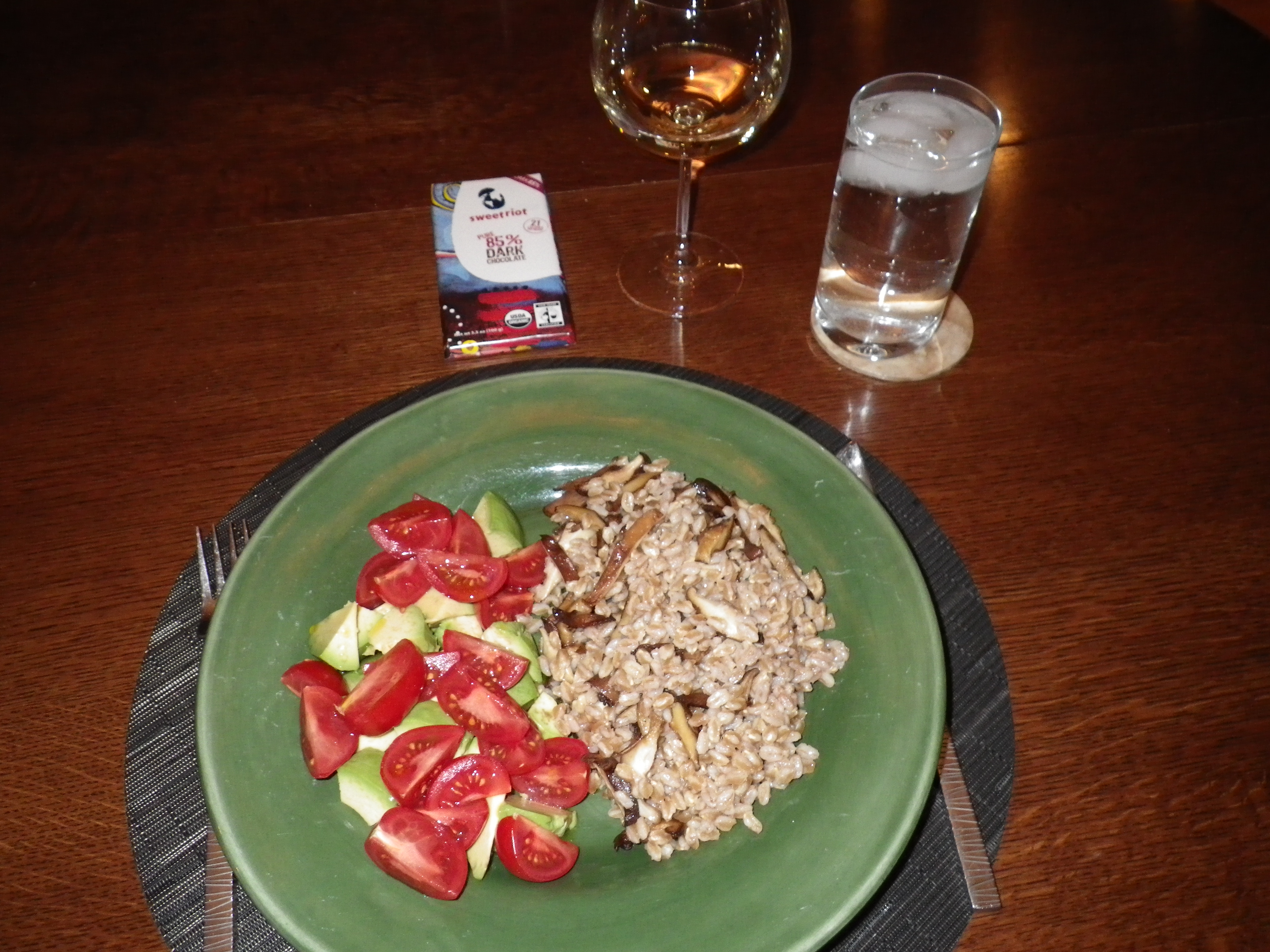
I sautéed shitake mushrooms in olive oil and mixed them with farro (a barley-like grain, chewy and flavorful)

Salad of cherry tomatoes and sliced avocado with some olive oil and white wine vinegar

Chardonnay (only 3 ounces…more disrupts my sleep and gives me a headache)

Sweet Riot 85% dark chocolate, 6 squares

Day 2

Breakfast:  Vanilla yogurt (1 cup) with ½ cup Müesli (Familia, no-added-sugar) and blueberries; Grapefruit Juice;  Black Coffee

Lunch:  Hummus and Feta on whole wheat bread;  Sliced apple;  English Breakfast tea

Snack:  1 banana;  lots of Water

Dinner

My favorite Escarole and Beans

Chardonnay (3 ounces again)

Dark Chocolate (another 6 squares of Sweet Riot 85%)

Day 3

All Bran cereal (2/3 cup) mixed with Early Bird Granola (1/3 cup) topped with blueberries; Grapefruit Juice;  Black Coffee

Snack:  Emmi Swiss Yogurt (creamy and sweet, as delicious as a dessert); lots of water

Lunch:  Whole Wheat cinnamon raisin toast topped with almond butter;  Sliced Pineapple;  English Breakfast Tea

Dinner

Aha!  My first test.  I had a date with my sister-in-law.  She’s always trying to lose weight (even though she is not heavy) and we were happily fantasizing about grilled brussels sprouts.  I had told her I was eating vegetarian while her brother/my husband was away.  My husband texted me that he would be home in time for dinner.  We switched restaurants to one that was larger and could accommodate all four of us.  What to eat?  I opted for the fish special (roasted Sea Bass in a sherry wine sauce – which was too sweet) and I substituted broccoli rabe for the risotto side.  It was good, but not great.  The problem with restaurant meals is that they cook with too much fat and too much salt.  I missed my healthy dinners.  And was so thirsty from the salt!

Okay, it’s Day 4 and how to continue?  Breakfast and lunch are easy.  I will have a whole wheat bagel with goat cheese for breakfast and a salad of quinoa and black beans for lunch.  For dinner, my daughter returns from Spain today and we are going to make one of her favorite family dinners:  Grilled steak tacos.  These tacos are delicious!  We grill steak, sauté corn and red pepper and red onion, top with guacamole and salsa, and roll it all up in one’s tortilla of choice (corn, plain, whole wheat).  I have been gradually eating mine with less and less steak and will continue to do so tonight.  A little bit of steak, probably 1-2 ounces.  And tomorrow, I will cook for my daughter.  She has been interested in eating more like me, so I will make our favorite Sunday morning oatmeal and our favorite Sunday lunchtime lentil soup.  For dinner, I am fantasizing about my husband’s grilled salmon – the very first thing he cooked for me 20 years ago when I fell in love with him.  I think we will be able to work out our eating differences – with love, respect and some compromise.

IMG_1371

Lentil Soup

  • 4 Tablespoons of olive oil
  • 4 garlic cloves, chopped fine
  • 1 cup of celery and carrots, chopped fine
  • 1 cup of Yukon gold potatoes, chopped
  • 2/3 cup of lentils (French Green)
  • 2 Tablespoons barley
  • Thyme, salt and pepper
  • 4 cups of liquid (Water or Vegetable Broth or Chicken Broth)  (I prefer Chicken Broth.  I am not a good vegetarian.  Water is too bland.  Vegetable Broth tastes weird.  Too sweet.  Sigh.)

Saute garlic, celery and carrots, potatoes in olive oil – for 10 minutes until lightly browned.

Add liquid, lentils, barley, seasoning.  Simmer for about an hour.

Serves 4 – 6.

“Who’s Your Favorite?”

IMG_1387

Love Is Not Finite

“You’re my favorite,” I winked conspiratorially at my son.

My 17-year-old daughter was packing for Spain and having a conniption about not being able to use her phone (the terribly backward iPhone 4).  We had arranged for a loaner Droid, but it was not up to her standards.  It was my fault.

My husband was scornfully not eating his delicious crabcakes for dinner, because I had forgotten to get tartar sauce to accompany them.  His dinner was ruined.  It was my fault.

My son had dutifully done his homework and uncomplainingly eaten his crabcake.  He pointed both out to me, leveraging the opportunity to come out on top of the family rating scale that evening.  And so, what else could I say but “You’re my favorite.”

“Ah!  Mom, do you know that that is the first time you’ve said that to me?” he replied with an earnest look into my eyes and a catch in his voice.

He is almost 14.  How could that be?

“Kiera, Daddy, even Cooper!  (our beloved parakeet) but never me,” he added, inserting knife and twisting.

Maternal guilt strikes.

“Who’s Your Favorite” had become a family joke.  All Aidan’s life, he has anxiously and eagerly demanded to know who was our favorite.  So sure it was his ambitious, obedient, over-achieving big sister.  So desperate for it to be him, we dealt with it by:

  1. Refusing to answer the question.
  2. Answering the question by naming anyone in our family community except for him – teasingly.
  3. Engaging in long, philosophical conversations about love.

How could he possibly be insecure about our love for him?!  We have enfolded him, literally and figuratively, into our arms, our lives, our hearts, profoundly.  I know no deeper love.  How does he not know this to the core of his soul?

When I was pregnant with him, I confided to my husband:  “I love Kiera so much.  I am afraid I won’t love another child as much.”  As an insecure only child, I had little-to-no experience with groupings of people, waxing and waning of friendships, sibling rivalry.  I did know what it was like to want to be the favorite of my parents in our dysfunctional triangle.   I, like Aidan, wanted people all to myself.  If there was fighting, it meant the love was gone.  I never experienced “normal” family fighting and making up and loving each other even when you disagreed or thought the other person was annoying.  My husband, one of three children, said gently to me: “Love is not finite.  You will make room in your heart for another child.”  How did he know?

Sure enough, when Aidan was born, my heart burst open more and there it was:  deep, profound, maternal love for this amazing creature.  So different from my first child.  He is sweet, sensitive, eager to please yet stubborn, charming, competitive, funny, empathetic, motivated by avoiding parental displeasure, disarmingly naïve, and deeply honest and transparent.  He pretty much would be happy staying home 24-7 and hanging out with us all day long.  He tolerates school, mainly because it is important to us.  His is a tough personality to have in a family where everyone else is busy being an over-achiever.

How can I help him feel secure that we love him and confident that his qualities are valuable?  It is challenging for me to not focus on academic and competitive achievements, because that is what I have spent my life valuing.  Aidan’s interests and talents lie elsewhere.

He is the best hugger I know and will happily spend unlimited amounts of time just being close.  Just being.  Not my comfort zone.  I want to encourage healthy, loving touch between mother and son.  Since I did not have that with my father, nor with my mother, it is difficult to know how best to be close.  Am I helping or hindering his appropriate development and eventual independence and separation?

He is not self-conscious.  He says what he thinks; he asks what he doesn’t know; and he is loyal to his family and his friends with intensity and without embarrassment.  There is no calculus of how is behavior or his words will impact his social standing or his cool factor.  He wears his heart on his sleeve.  As first grade teacher Mrs. Goldman whispered to me at our parent-teacher conference, “Aidan is a treasure.”  Yes, he is.

He plugs away at all that we ask of him, with mixed ability and mixed results.  He is diligent, resistant, a procrastinator, a day-dreamer, hard-working, lazy, thoughtful, creative.

He makes me laugh.

He remembers the words to all the tv commercial jingles.  (But not the words to all the math theorems.)

My interactions with him frequently take the form of nagging.  Did you do your homework?  When is your next math exam?  Did you read the chapter for ELA yet?  Pick up your clothes.  Make your bed.  Set the table.  Take a shower.  The time we spend together revolves around working on homework or driving to tennis clinic.  It is wearing us both out.  Surely there is more for us to talk about and do together?  I am at fault.  On the treadmill of life and achievement, I want to make sure he is keeping up.  Instead of quizzing him, perhaps I should listen to him, say yes more, and be open to what he has to teach me, to offer me.  Lessons on how to love, how to relax and have fun, how to be.

A few weeks ago, Aidan invited me to go to the movies with him.  I suppressed my impulse to say “No, I’m too tired on Fridays and just want to go home and relax.”  After all, how much longer will a 13-year-old boy want to go to the movies with his mom?  We went out to dinner afterwards and shared our thoughts about the movie.  And then we did it again the following week.  And again the following week.  Maybe this will be our thing.  It is for now.  When I get out of the house I’m not consumed with all the chores I should be doing and all the homework he should be doing.  When we get out of the house, we can just be ourselves, having fun together.

Rejected!

IMG_1382

Resilience (Part 2)

“Fuck You New York Times” was my first reaction.

“I’m not a good writer after all.  I can’t do it.  I quit!”  was my second reaction.

Whoa!  What?  Both reactions require me to be angry, depressed, hiding away licking my wounds in victim-y self-pity.  Swinging between the extreme undemonstrativeness of my father where everything I did got a “fair” assessment and the blind adoration of my mother where I could do no wrong, I am an odd mixture of hubris and anxiety that I am a failure.  Any success I have is dubious, because I am a fraud and have everyone fooled.

The experience of submitting my essay – in actuality – differed from the experience in my mind.  In my mind, the New York Times enthusiastically accepted my submission within 24 hours, eager to publish it immediately.  That Sunday!  I was planning the announcement to my community of friends, family, colleagues, and maybe a few frenemies.  (Hah!  See!  I showed you!)  I was the undiscovered great essayist they’ve been waiting for.  I would become famous and admired for my honest and beautifully written personal remembrances.  I would get a book deal!  True, I would have to confront going public with my stories, most frighteningly to my parents.  But I was ready.  If not now, when?  It was time.  How dare they reject my submission?  I had already planned out my future – all based on their acceptance!  Fuck the New York Times.  I must be a failure and a fraud after all.

That night, my husband was tired of kids’ tennis duty and asked me to pick them up.  I passively aggressively agreed.  This was cutting into my time – it was my night to work late or sneak in a yoga class or just go home and have the house to myself to write.  Besides, I was out of sorts from receiving the rejection email – one month, precisely, from the day I had submitted it, as promised by their precise submission guidelines.  I grumbled out of the house and got into the car and turned on WNYC.  And was transfixed.  The Moth Radio Hour was on.  In my heightened awareness of writing and story-telling, what could have been better?  Josh Axelrad was telling his story of gambling.  His word choice was sophisticated and intricate, his timing and intonation were amazing, his story was riveting.  Wow.  Now that’s how to tell a story!  Fuck the New York Times.  I must be a failure and a fraud after all.

Now what?  Deep breath.  Pause.  Take a day, or a week, or a month, to consider my next steps.  I don’t have to react immediately or impulsively or emotionally.

What now, is that after 50 years of rejections and acceptances I can find a middle ground.   I am a good but new and inexperienced writer.  Maybe the rejection has nothing to do with me and my essay.  Maybe it just didn’t fit the direction they want to go with the column.  Maybe I should submit it somewhere else.  I can do that.  I don’t have to quit.  I can keep writing, keep practicing, honing my skills, getting my 10,000 hours in.

At 17, I was not so patient.  I had been obsessed with ballet.  For all of 2 or 3 years.  Dancing 4 hours a day, 6 days a week, I probably had about 4,000 hours in when I decided to audition for New York City Ballet’s School of American Ballet.  Not a city kid, my mother and I took the train from D.C. to New York, where I was overwhelmed with the monolithic gray busyness of the city.  We took a taxi from Penn Station to Lincoln Center.  We found the dark and cramped administrative corridors in the bowels of Lincoln Center leading to the seemingly enormous mirror-lined dance studios of the school.  I was too nervous to remember much.  My mother had made the appointment, so I had a private audition not a cattle call.  I went into the locker room to change and then they brought me to the studio.  Two older women with Russian sounding accents were there.  Not unkind, they looked me over.  I pliéd and did a glissade.  And that was about it.  Perhaps they had me do a small combination in the center of the grand old studio.  That was enough for them to know that I was not what they were looking for.  I was not tall enough.  I was not ethereal enough.  I was not uniquely talented enough.  I didn’t have my 10,000 hours in.  They suggested that I go to a college with a strong dance program and explore other forms of dance that were not so exacting.  Excellent advice that I could not hear.  I was determined to be a ballet dancer at the most prestigious dance company I was aware of.  That was the future I had imagined in my mind.  They rejected me.  Closed off to other possibilities, I quit ballet.  Later, I quit college to return to ballet – but with similar results.  Bouncing between extremes, I never let myself enjoy being good enough – open to possibilities other than greatness at something ridiculously hard to achieve.

Now what?  What now is that I can practice resilience, mindfully choosing flexibility and optimism.  Rejection is not a tragedy.  It is an opportunity.  Your loss, New York Times.  (sigh, still angry)  I will practice my writing and find other venues to publish and to reach an audience.  Just as there are myriad other profoundly amazing dance companies and dancers (which, regretfully, I was not wise enough at the time to explore – sigh, still sad), so there are other ways to tell stories.